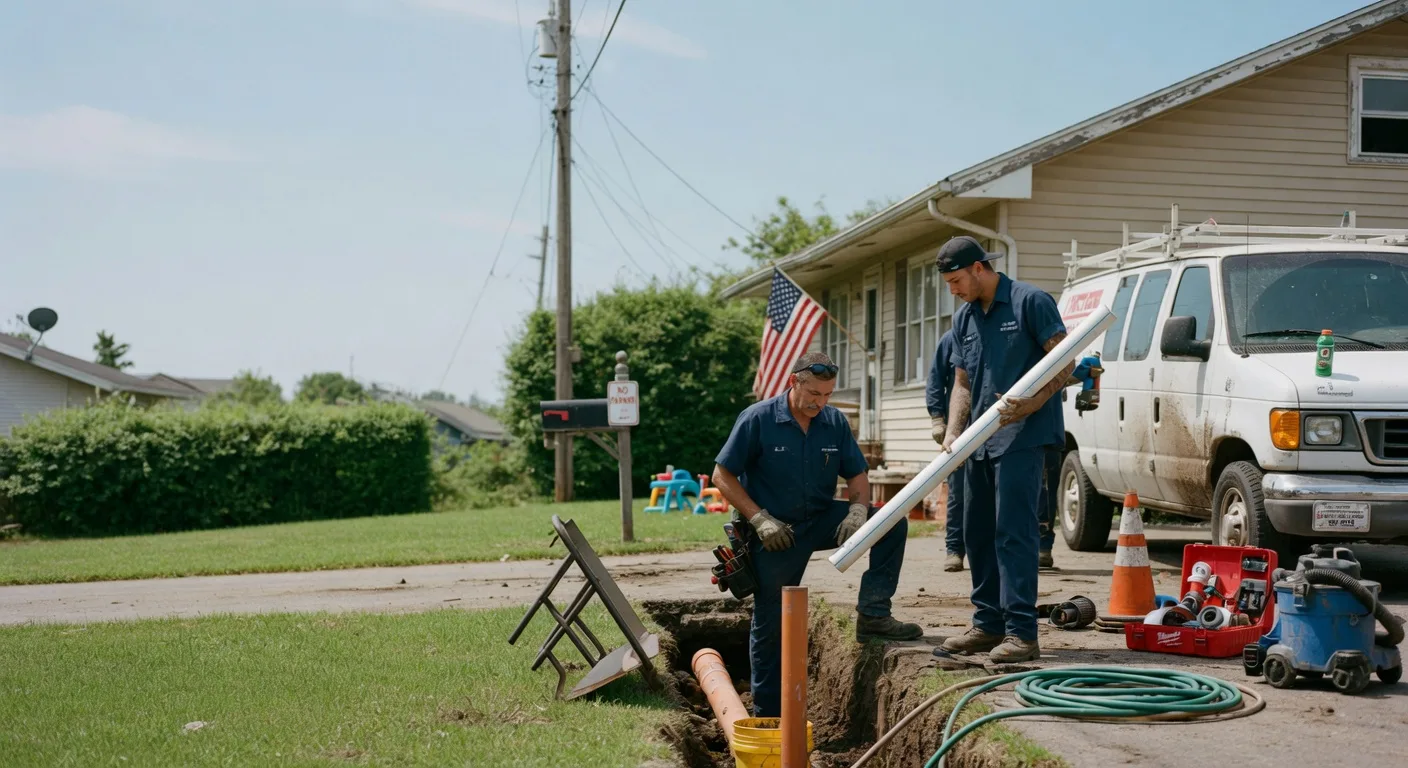
What does grease actually do to a drain pipe?
Grease leaves the sink as a liquid, and the pipe is where it stops being one. Warm fat cools on contact with the cold pipe wall and hardens into a waxy layer. That layer is slightly sticky, so it grabs coffee grounds, food scraps, and lint, and each meal adds another coat. Over weeks the opening shrinks like an artery, and water that used to flow freely starts to drain slowly and gurgle. Hot water does not fix this; it only carries the grease farther down the line, where it cools and sets again, sometimes in the main. That is why a kitchen sink that slows while every other fixture drains normally is nearly always grease in the branch line close to the trap. A cable machine cuts a channel through the buildup and often restores flow, but the coating stays on the pipe wall and narrows again within weeks. Hydro jetting sends high-pressure water around the whole interior and strips the grease off the pipe wall, which is why it is the usual answer for repeat kitchen clogs. Wiping pans with a paper towel and putting fat in the trash prevents most of it. Expert Plumbers Co connects homeowners with an independent local plumber who can tell whether a cable or a jetter fits the line. Access and the amount of buildup affect the job.
The place where most people go wrong is the hot water habit. Running hot water for a few seconds after washing dishes does not carry grease to the sewer, it only moves it down the line a few feet, where it cools and sets. A much better routine is to scrape plates into the trash, wipe greasy pans with a paper towel, and keep a jar for cooking oil that can go in the garbage once it is full. Dish soap makes grease look like it has dissolved, but it only breaks it into smaller droplets that still stick further along. Garbage disposals do not solve this either, since they chop food without removing the fat. In restaurants and busy households, a grease trap or interceptor may be present, and it needs regular emptying. If the sink has slowed repeatedly, mention that to the plumber, since a pattern points to a coating that needs scouring rather than another quick clear.
Why does my house smell like sewage even though nothing is backed up?
A sewer smell with no visible backup usually means sewer gas is getting into the house through a path other than a clog. The most common cause is a dry trap. Every drain has a U-shaped trap that holds water as a seal, and in a rarely used drain, like a basement floor drain or a guest bathroom, that water evaporates. Pouring a bucket of water down the drain refills the seal, and it often fixes the smell in minutes, so that is a safe homeowner check. A loose or failed wax ring under a toilet can leak gas at the base, and a rocking toilet is a clue. A cracked vent pipe in the attic or wall can release gas inside the house. Outside, a damaged sewer line or an open cleanout can send the smell into the yard and then indoors. If the smell is strong, comes with slow drains, or you feel dizzy or sick, leave the area and call right away. If it lingers after you refill the traps, the vent stack or the sewer line itself may need a camera check. Call Expert Plumbers Co at (380) 262-9173 to get connected with an independent local plumber in Goodspring, TN.
One thing worth knowing is that the smell often follows a pattern, and the pattern points to the source. If it is strongest right after you run a shower or flush a toilet, the gas is probably escaping from a leaking drain joint or a cracked vent inside a wall. If it comes and goes with the weather, a low-pressure day or strong wind can pull gas back down a vent. In older homes, deteriorated cast iron or lead-and-oakum joints are common leak points. Newer homes with plastic pipe more often have a missed glue joint or a dried trap. When you talk to the plumber, say which room the smell is in, what time of day it shows up, and whether it changes after water use. That detail can save an hour of searching. Expect the fix to be small if a trap or wax ring is the cause, and larger if a wall has to be opened to reach a joint.
We just built or remodeled and the drains are already slow. Why?
The plumbing is new, and the tub drains like an old one. Or the sink gurgles whenever the washer runs. New work should not do this, and the cause is usually in how the pipe was set.
Four causes come up. First, not enough fall on a horizontal run. Water needs slope to carry solids, and a flat run leaves them behind. Second, a vent that was never tied in or was capped. The line cannot breathe, so you get gurgling and slow flow with no clog. Third, construction debris left in the line: grout, drywall mud, thinset, sand. It sets hard on the pipe wall. Fourth, a trap arm run too long.
One slow fixture points to its own trap arm, slope or vent. Several fixtures slow together, or the lowest drain backing up, points to the main run, a debris plug or a vent problem.
Safe homeowner check: note which fixtures are slow and listen for gurgling. Do not climb onto the roof. Stop running water and call now if water or sewage comes up in a tub or floor drain.
A camera inspection is the right first step on new work. It shows a flat section, a ridge of hardened material on the pipe wall, or a vent that never connected. Repeat cabling just pokes a hole through the problem, and it returns. A cable machine is enough for a soft, loose blockage. Hardened cementitious debris often needs hydro jetting. Slope and vent faults need the piping corrected, and what that involves follows access, materials, how much has to be opened up, and any permit or inspection.
Expert Plumbers Co is a referral service. We refer homeowners in Goodspring, TN to an independent local plumber for Drain Cleaning and Emergency Drain Cleaning. Call (380) 262-9173.
Keep a record while the work is fresh. Photograph any open walls or trenches before they are closed, and write down the date the slow drains first showed up. If a builder or remodeling contractor did the work, the fault may be theirs to answer for. A written note from the plumber describing what the camera found, such as a flat section or hardened debris, helps far more than a general complaint.
Tell the plumber when the work finished, which fixtures were added and whether the main line was touched.
A common mistake is pouring strong drain chemicals into a new line. They rarely touch hardened grout or thinset, they can damage fittings, and they make later cabling or jetting unsafe for whoever handles it. Another is waiting for the problem to settle. Construction debris does not wash away. Ask whether any air admittance valves were used in place of a full vent, and whether local code allows them.
Is this a water supply problem or a drain problem?
Water that will not leave is a drain problem. Water that arrives wrong is a supply problem.
Supply problems show up as weak pressure, water that runs hot or cold when it should not, a meter that keeps turning, or a wet spot where the water is clean. Drain problems show up as water that will not go down, gurgling, a sewer smell, or dirty water coming back up through a tub or floor drain. A jump in the water bill points to supply, not drainage.
A wet patch in the yard can be either. The giveaway is the water itself. Clean and odorless points to a supply leak. Gray, dark or smelly points to a drain, often a failed sewer lateral or a root-damaged joint.
Safe homeowner check: shut off every fixture and appliance, then look at the meter dial. If it still turns, water is escaping somewhere. Next, run one drain at a time and note which ones are slow.
One slow fixture is its own branch line, and a cable machine often clears it. Several fixtures slow together point to the main line or a blocked vent stack. A repeat problem can need a camera inspection or hydro jetting instead of a cable.
Stop running water and call now if sewage is coming up in a tub or floor drain, if every drain in the house is backing up, if a clean leak will not stop, or if water is near electrical equipment.
What the work involves depends on access, the pipe materials, how much has to be opened up, and any permit or code requirement. Expert Plumbers Co is a referral service. Call (380) 262-9173 and we will refer you to an independent local plumber in Goodspring, TN.
Two cases fool people. The first is a toilet that keeps refilling. It wastes supply water, yet it can look like a drainage fault because water is always moving. Listen for a hiss when the house is quiet, then put a little food coloring in the tank. Color in the bowl without flushing points to a worn flapper.
The second is a hot water line leaking under a slab. Signs include a warm patch on the floor, a water heater that seems to run constantly, or the sound of water with every fixture off. That is a supply problem and needs a different approach from drain cleaning.
Pressure tells you something as well. Low pressure on hot water only points at the water heater or its valves. One weak fixture often means a clogged aerator or a partly closed shutoff, usually from mineral scale. Note which case fits before you call, so the right tools and parts come with the plumber.
Can I rent a hydro jetter or a big drain machine and do the main line myself?
"Can I just rent a hydro jetter and do the main line myself?" You can rent one at many tool shops, so it is a fair question. The honest answer is that it is a bad bet on a main line, for reasons of both pipe and safety.
A hydro jetter pushes water at very high pressure through a hose with a nozzle that pulls itself down the pipe. In the right hands, on sound pipe, it cleans grease and scale off the pipe wall. In the wrong hands it can break old clay or cast iron, wash out joints, drive water into a cracked pipe, or punch through a thin spot. Root intrusion at a clay joint can hold the nozzle, and a bellied line can trap it.
A large drain machine has its own risk. The spinning cable can whip, snag and twist. It can wrap a hand or arm in a second.
There is a bigger issue. Without a camera, you do not know what you are cutting. A main line that backs up may be roots, a bellied line, a collapsed section or a failed sewer lateral. Clearing the blockage may only open a hole through it, and it returns soon after.
Safe homeowner check: Run one fixture at a time and note which drains slowly. Check if it is one fixture or every drain in the house. Do not pour drain chemicals into a line that is backing up.
Stop running water and call now if sewage is coming up in a tub, shower or floor drain, the toilet bubbles or rises when you run other fixtures, or you smell sewage in the house. Stop using water in the house until the line is cleared.
A cable machine is enough for a simple clog in a branch line. Hydro jetting is for grease and scale on the pipe wall. A camera inspection is the step that tells the plumber what is in the pipe and what tool is safe to use, which is what a rental cannot give you.
Expert Plumbers Co is a referral service. We connect you with an independent local plumber in Goodspring, TN. Call (380) 262-9173.
Ask the plumber to show you the camera footage and explain what was found. Ask whether the pipe is sound enough for jetting. Cost depends on access to a cleanout, the parts or materials needed, how much has to be opened up or removed to reach a damaged section, and any permit or code requirement.